← musicforrobots.com FREE VSTs
MUSIC FOR ROBOTS // AUDIO PLUGINS

FREEVSTs

Free, open-source plugins from Music For Robots. No accounts, no licence keys, no catch. Use them in anything you make, including commercial releases.

PLUGINS

The rack.

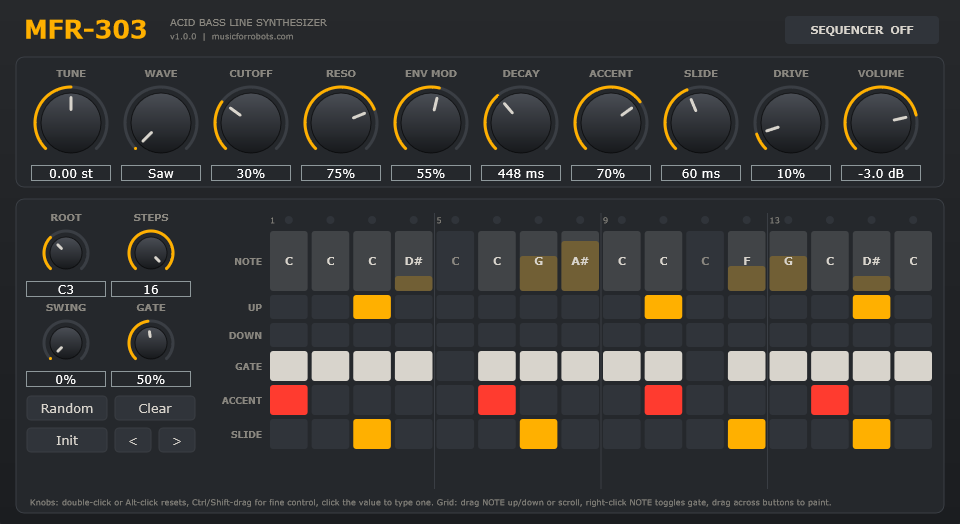
The MFR-303 interface: ten synth knobs above a 16-step sequencer grid

MFR-303

Acid bass line synthesizer.

  • VST3 + Standalone
  • Windows 64-bit
  • Open source (AGPLv3)

A monophonic bass synth in the spirit of the 303. It has the squelching resonant filter, the accent and slide that make acid lines move, and a step sequencer that syncs to your DAW.

  • Diode-ladder style filter, oversampled. Resonance thins the low end the way the original does.
  • Accent and slide. Accents stack up when they come in a row.
  • 16-step sequencer with note, octave, gate, accent and slide per step, plus swing and a randomizer. Or play it from your piano roll.
  • Drive for when clean isn't the point.
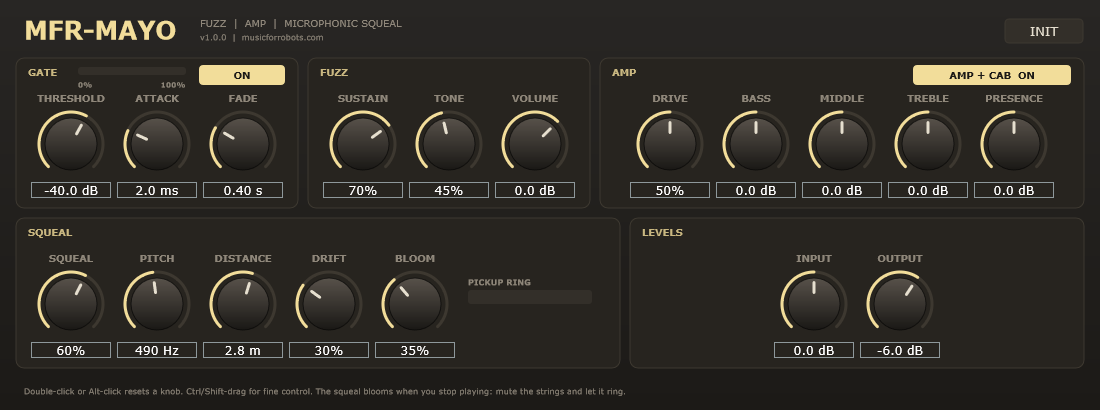
The MFR-Mayo interface: gate, fuzz, amp, squeal and level controls

MFR-Mayo

Fuzz, amp, and a pickup that sings.

  • Guitar effect
  • VST3 + Standalone
  • Windows 64-bit
  • Open source (AGPLv3)

A 90s-style op-amp fuzz into a cranked British amp, with a cheap microphonic pickup in the loop. Play through it and it's a thick, scooped wall of fuzz. Stop, and the rig starts to whistle.

  • Real feedback, simulated. Nothing triggers the whistle. It builds when your strings stop, jumps between pitches and sags, like the real thing.
  • Squeal controls for how microphonic the pickup is, where the whistle sits, and how much it wanders.
  • Gate first in the chain, so it's quiet when you're not playing, and you decide how long the whistle rings.
  • Amp and cab bypass if you'd rather use your own amp sim.
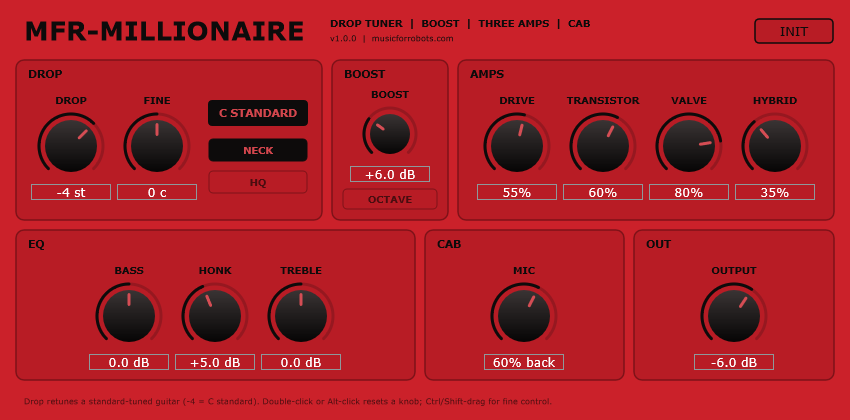
The MFR-Millionaire interface in red and black: drop tuner, boost, three amps, EQ and cab controls

MFR-Millionaire

C standard without touching the tuning pegs.

  • Guitar effect
  • VST3 + Standalone
  • Windows 64-bit
  • Open source (AGPLv3)

Plays your standard-tuned guitar as if it were tuned down, then runs it through an early-2000s desert-rock rig: a boost, three very different amps blended together, and a cab miked from across the room.

  • Drop tuner, 0 to 12 semitones, with a readout of the tuning you're in. About 9 ms of latency, so you can play through it live, or an HQ mode for re-amping.
  • Three amps in parallel: a scratchy transistor head, a warm valve combo and a wild hybrid.
  • Honk control for that nasal ~600 Hz midrange, and a mic you can pull back into the room.
  • Boost and octave fuzz in front of it all.
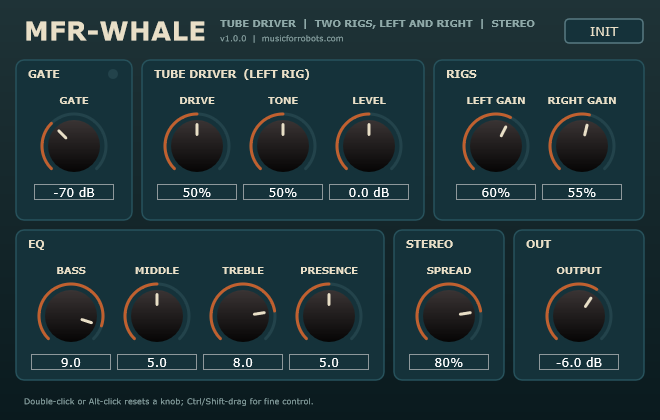
The MFR-Whale interface in deep sea blue: gate, tube driver, two rigs, EQ, stereo spread and output

MFR-Whale

Two guitarists, two rigs, one guitar.

  • Guitar effect
  • Stereo
  • VST3 + Standalone
  • Windows 64-bit
  • Open source (AGPLv3)

Your guitar through two different amp rigs at once, one on each side, for a huge double-tracked mid-2000s sludge and prog-metal wall.

  • Left: a valve overdrive pedal into a bright, loose '70s lead head.
  • Right: an '80s head with 6550 power valves, tighter and deeper.
  • Spread from a centred blend to a wide wall that sounds like two separate takes.
  • Level-matched sides, a gate, and effectively zero latency.
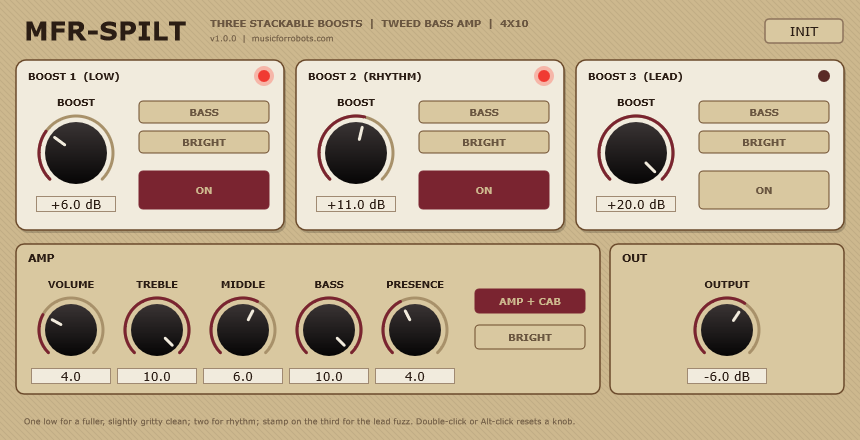
The MFR-Spilt interface in tweed: three cream boost pedals above an amp panel

MFR-Spilt

Three boosts, one cranked amp.

  • Guitar effect
  • VST3 + Standalone
  • Windows 64-bit
  • Open source (AGPLv3)

No distortion pedal. Three clean boosts in a row push a tweed bass amp into break-up, for that late-'90s indie-rock overdrive: one for a gritty clean, two for rhythm, all three for the lead.

  • Three stackable boosts, each with its own footswitch, level, and bass and bright switches.
  • A tweed amp whose tone stack is modelled on the real circuit, with that deep low-mid scoop.
  • Voiced against a reference recording, so the defaults land close to the record.
  • Amp + cab bypass to put just the boosts in front of your own amp sim.
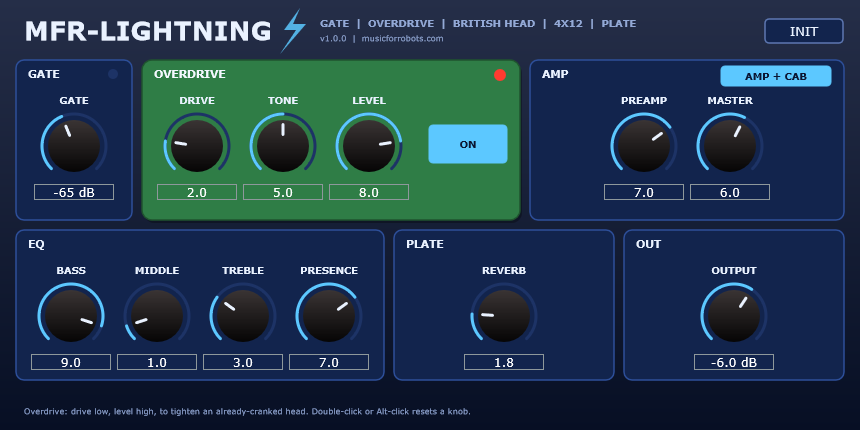
The MFR-Lightning interface in electric blue: gate, a green overdrive pedal, amp, EQ, plate and output

MFR-Lightning

Tight, scooped, early-'80s thrash.

  • Guitar effect
  • VST3 + Standalone
  • Windows 64-bit
  • Open source (AGPLv3)

A gate, a mid-hump overdrive pushing a cranked British master-volume head, a 4x12 and a plate reverb: the palm-muted gallop sound of early-'80s thrash.

  • Overdrive that tightens: it only clips above ~720 Hz, so drive low and level high pushes the amp without fizz.
  • A British master-volume head whose tone stack is modelled on the real circuit, defaulting to the scooped setting.
  • Voiced against a reference recording, within about 2 dB of its rhythm guitars.
  • Gate and plate reverb built in, plus an amp + cab bypass.
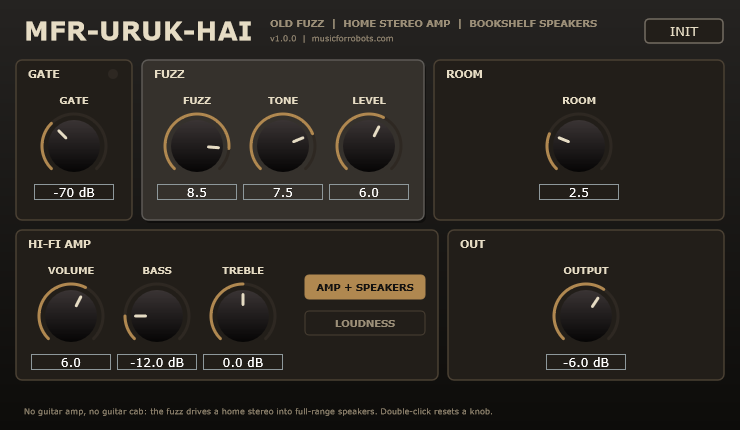
The MFR-Uruk-Hai interface in charcoal and parchment: gate, fuzz box, room, hi-fi amp and output

MFR-Uruk-Hai

No amp, no cab, no mercy.

  • Guitar effect
  • VST3 + Standalone
  • Windows 64-bit
  • Open source (AGPLv3)

Raw early-'90s lo-fi black-metal guitar, the wrong way round on purpose: an old fuzz into a home stereo amplifier and full-range bookshelf speakers. Buzzy, fizzy and bright.

  • Old fuzz with lopsided clipping and a starved-battery spit.
  • A home stereo amp instead of a guitar amp: hi-fi Bass and Treble, a Loudness switch, and solid-state buzz when pushed.
  • Bookshelf speakers, not a guitar cab, so the top end stays up.
  • Voiced against a reference recording, within about 1.5 dB.
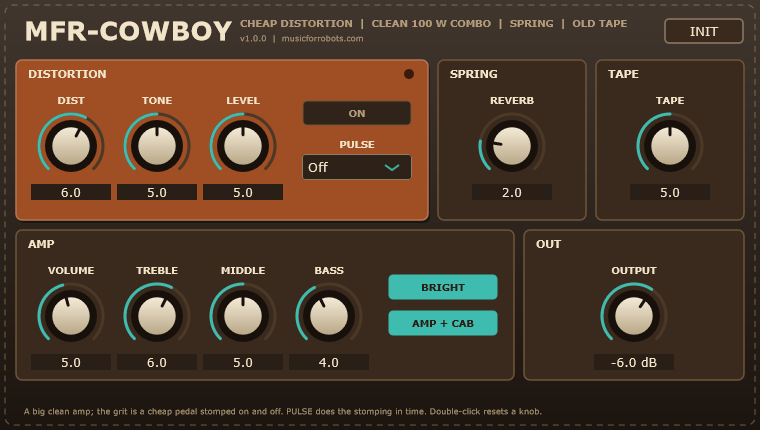
The MFR-Cowboy interface in saddle leather and turquoise: a burnt-orange distortion pedal with PULSE, spring, tape, amp and output

MFR-Cowboy

Big clean combo, cheap pedal, stomped in time.

  • Guitar effect
  • VST3 + Standalone
  • Windows 64-bit
  • Open source (AGPLv3)

Late-'90s Northwest indie guitar: a big, clean, bright 100 W combo with six 10-inch speakers, a spring reverb and old tape. The grit comes from a cheap distortion pedal stomped on and off, and PULSE does the stomping for you.

  • PULSE switches the distortion on and off in 1/4, 1/8 or 1/16 notes, locked to your DAW's tempo.
  • A blackface-style clean combo with a tone stack modelled on the real circuit and a Bright switch.
  • Voiced against a reference recording, within about 2 dB of its clean guitar.
  • Spring reverb and old tape built in, plus an amp + cab bypass.
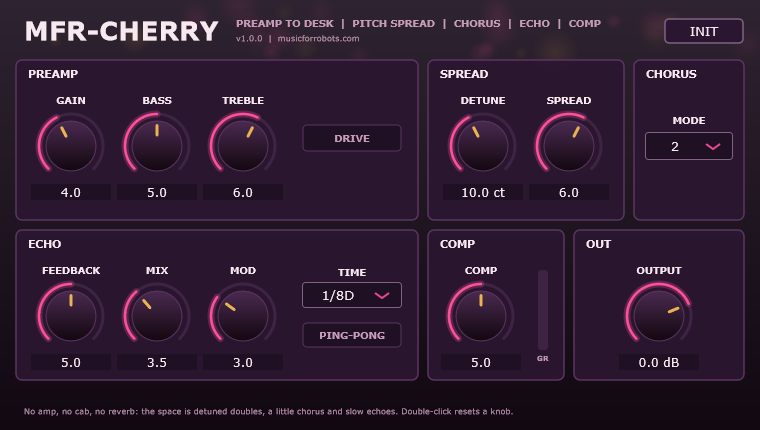
The MFR-Cherry interface in plum, neon pink and gold: preamp, spread, chorus, echo, compressor and output

MFR-Cherry

No amp, no cab, no reverb. All shimmer.

  • Guitar effect
  • VST3 + Standalone
  • Windows 64-bit
  • Open source (AGPLv3)

1990-era dream-pop guitar, chiming and wide: a preamp straight to the desk, detuned doubles spread left and right, a little chorus, and slow echoes synced to your tempo, all squashed together by a compressor.

  • Clean valve or solid-state drive preamp, with no amp or cab in the way.
  • Pitch spread: a copy a few cents flat on the left and sharp on the right, like an instant double-track.
  • Dimension-style chorus with four modes, and a tempo-synced echo with modulation and ping-pong.
  • A fast compressor with a gain-reduction meter to glue it all together.

More plugins are on the way. This page is where they'll turn up.

INSTALLING

Two ways in.

Each plugin's download page has two files:

  • The installer (…-setup.exe) puts the VST3 in the standard folder and can also install the standalone app. It adds an uninstaller as well.
  • The zip is for doing it yourself. Copy the .vst3 folder into C:\Program Files\Common Files\VST3\.

Then rescan plugins in your DAW. In FL Studio, that's Options › Manage plugins › Find plugins.

QUESTIONS

Before you ask.

Windows says it "protected your PC".

The installers aren't code-signed yet, so Windows SmartScreen doesn't recognise them. Click More info, then Run anyway. If you'd rather skip the installer entirely, use the zip.

Mac? Linux?

Windows only for now. The code is portable, so other platforms are possible later.

Is it really free?

Yes. The plugins are free to use in your music, commercial releases included. The source code is public under the GNU AGPLv3. If you change the code and distribute it, you share your changes under the same licence.

Found a bug, or have an idea?

Open an issue on the plugin's GitHub page: MFR-303, MFR-Mayo, MFR-Millionaire, MFR-Whale, MFR-Spilt, MFR-Lightning, MFR-Uruk-Hai, MFR-Cowboy, MFR-Cherry.

VST is a trademark of Steinberg Media Technologies GmbH. TB-303 is a trademark of Roland Corporation. Big Muff is a trademark of Electro-Harmonix. Marshall is a trademark of Marshall Amplification. Music For Robots plugins are independent and are not affiliated with or endorsed by any of these companies.